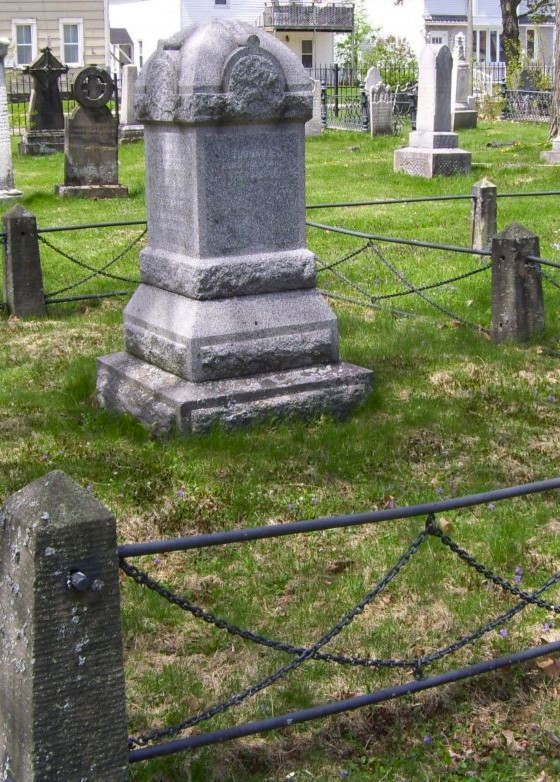
John Neill (1819 - 1893)


Yesterday, John NEILL passed away at his home in Gibson (York Co.). He had been inflicted for some time with enlargement of the heart and this culminated in his death. He came to this country about the year 1842 from Whitborn in Scotland and for a time after coming out he taught school. He then engaged in the hardware business in the firm of Stewart & Neil. He was always a most enterprising man and is said to have introduced from the Scotland the first bone crushing mill ever brought to this country. He was connected through his mother with the Stewarts of the largest hardware house in Edinburgh. 

He leaves two sons and five daughters living: Jas. S. NEILL, hardware merchant, Albert NEILL, Mrs. J.F. McMURRAY, Mrs. W.R. LOGAN, Mrs. Wm McKAY, Mrs. Arthur SEWELL and Miss Alice NEILL. His widow survives him. 

He was a prominent member of the St. Andrew's Society of which he was secretary from 1847 to 1852. He also occupied the offices of 1st and 2nd vice-presidents. Through his instrumentality the Fredericton Curling Club came into existence. 

The funeral takes place tomorrow 2:30 o'clock from his residence. The remains will be interred in the old burying ground. 

(The Gleaner, February 20, 1893)

Comments

Popular posts from this blog

Thomas R. Robertson (1795 - 1878)

Thomas R. Robertson was the first Treasurer for the Society of Saint Andrew. He served from 1825 to 1828, and was also President in 1846 and 1847. Born in Scotland, Thomas arrived to Fredericton in 1818 – along with his friends Robert Gowan, and John Gregory – all with the 74th (Highlanders) Regiment of Foot.  When his regiment departed Fredericton in 1823, he stayed behind, joining the merchant firm of Thomas L. Langen as a clerk. Thomas soon became a full partner, and their business operated under the name of Langen & Robertson. This continued until 1831, when Mr. Langen retired and the business was then taken over by Thomas.  T. R. Robertson’s store was located on the west end of Queen Street, and continued to operated in the same location. On August 2, 1839 his store was destroyed by a fire – described by the Fredericton Sentinel as the most disastrous of the decade. Nevertheless, T. R. Robertson’s store was rebuilt and continued for another 17 years. Thomas was a hig...

Scots in the Old Burial Ground

SCOTS AND THE OLD PUBLIC BURIAL GROUND, FREDERICTON  by Dr. Ellen MacGillivray, c. 1991 When John Ross and I were co-historians of the Fredericton Society of Saint Andrew from 1985-1987 we had not yet started to sort the Society's documents left in John's care by late Dr. D. J. MacLeod. We became interested in finding the burial plots in the Old Public Burial Ground of the Chartered Members of the Society as well as those of others who came later. But first some notes on the place itself.  THE OLD PUBLIC BURIAL GROUND  According to Dr. Lillian Maxwell (1937) on August 2nd, 1785 the Governor-in- Council appointed Trustees to lay out Fredericton. One of these Trustees was Lieutenant Dugald Campbell who made the survey in 1785-1786: "The Town Plat as first laid out extended from Smythe street to Sunbury street and from the river to Charlotte street. The blocks were laid out to cover four and a half acres, the streets one chain wide. A square was laid out in the middle of th...

Peter Fraser (1765 - 1840)

Peter Fraser was the first President of the Fredericton Society of Saint Andrew. He served for seven years. In 1923, the then President Mr Justice Oswald S. Crocket wrote extensively about him:  Peter Fraser, the first president of the Fredericton Society of Saint Andrew, was a leading merchant and one of the most prosperous and prominent citizens of Fredericton. Born at Forres, Morayshire, Scotland in 1765, he came to New Brunswick in his eighteenth year about the time it was founded as a separate Province in 1784, and by his native ability and unremitting industry and prudence soon hewed out the path upon which he advanced to business success and public prominence.  As early as 1789, Mr. Fraser purchased from William Garden (original grantee) the block of land bounded today by Queen, Church and King Streets, situated beside Parliament Square. Not long afterwards, he built a residence on the Queen Street side of his property (today known as Farraline Place). Later he built a ...